How to Read Array Into Array C++
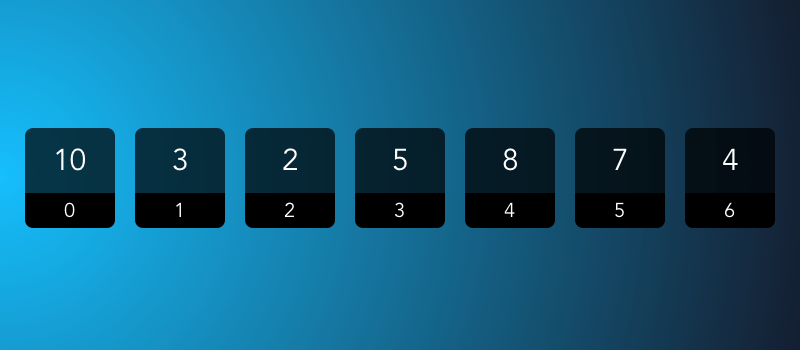
Arrays in C allow you to store multiple items of the same data type, such as a list of integers. Arrays grade the footing for many data structures and let yous to build advanced programs.
In this commodity, we are going to discuss what an array is and how you can use them, along with examples. We volition also see the concept of "strings", which is closely related to the topic of arrays.
Contents
- 1 What is an assortment in C and why should you lot utilize them?
- 2 Declaring and using an array in C
- 3 Culling ways to initialize arrays
- 4 Looping/iterating over an array in C
- 5 Array program examples in C
- v.1 Reading user-entered numbers into an array
- 5.2 Linear search in an array
- 6 Two-dimensional (2d) arrays in C
- 7 Initializing, using and looping over 2D arrays
- 8 2D array programme examples in C
- viii.1 Reading user-entered numbers into a 2D assortment
- viii.2 Finding the transpose of a matrix
- 8.3 Adding two matrices
- 8.4 Multiplying ii matrices
- 9 Multidimensional arrays in C
- 10 Strings in C: Arrays of Characters
What is an assortment in C and why should y'all use them?
In C, an assortment is a fashion to shop a fixed number of items of the same data type under a single name. Each data detail of the assortment tin be accessed by using a number called an "index" or "subscript".
You might think, why do we need arrays to store multiple data types, when you can just declare normal variables? Allow us take an example — suppose, you take been asked to write a program that takes in the temperature for the last 90 days and perform some processing on that data.
With enough time and patience, you can declare 90 integer variables (such as a1, a2, a3 and and then on) to shop this information. However, processing the information in these 90 variables is nearly impossible. What if you wanted to know the average temperature between a range of days (such as the 10th and 25th twenty-four hours), where this range would be given by the user?
While yous can't practise this with normal variables, you tin can utilize arrays to make such a program. You can store all the temperature values under a unmarried variable like a, so extract any set of values from it by using the index.
Declaring and using an array in C
To declare an array, you simply demand to specify the data type of the assortment elements, the variable name and the array size. For case, if y'all desire to declare an integer array with iv elements, you lot'd utilize:
int a[ 4 ];
This statement allocates a contiguous block of memory for four integers and initializes all the values to 0. This is how information technology is laid out in memory:
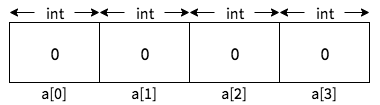
Array indexes start from zip and finish with (array size – 1). So for the above array, you can employ the offset element with a[0], second chemical element with a[1], 3rd element with a[ii] and fourth (last) element with a[3].
You tin can utilize the indexes to prepare or go specific values from the assortment. Hither are a few examples:
a[0 ] = x ; a[ 1 ] = 20 ; a[2 ] = a[ 1 ] / a[ 0 ]; // a[2] will be set to 20/x = 2 a[ 3 ] = a[ ane ] - 2 ; // a[three] will be set to 20-2 = 18
After these changes, here is how the assortment volition look like in retentivity:
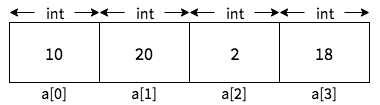
Autonomously from the square brackets to point the index, array elements behave like normal variables. And then, for instance, you can print them by using:
printf(" %d %d %d %d \northward " , a[ 0 ], a[ 1 ], a[ two ], a[ 3 ]);
Y'all can run across the total program in action beneath, or download it here.
One of import thing to note is that C does non enforce any assortment bounds checks, and accessing elements outside the maximum index volition pb to "undefined behaviour". So, in the to a higher place example, trying to get or set a value like a[5] tin can cause your program to crash or behave abnormally.
Culling ways to initialize arrays
Previously, we've seen how to declare an array and set its elements. Nevertheless, if yous know the elements of the array, so there is an easier way to declare the array. For example, you want to declare an integer assortment with the values x, xx, 30, xl, you tin use the "initializer list" syntax:
int a[ four ] = { 10 , 20 , 30 , 40 };
This argument will automatically create an array of size 4, and initialize a[0] to 10, a[one] to 20 then on. To confirm that this works, you tin impress the variables, just like we did in our previous program.
You can also make an array that is bigger than the initializer list, like and then:
int a[ 6 ] = { 10 , 20 , 30 , twoscore };
In this case, the residual of the elements are initialized with naught. In our higher up instance, elements from a[0] to a[iii] will exist initialized, whereas a[4] and a[five] volition be set to naught. Once again, you can hands verify this by writing a program:
You tin can besides skip the array size when using initializer lists, like in the example below:
int a[] = { 10 , 20 , thirty };
The C compiler automatically guesses the size of the array from the size of the initializer list. Then, the above example is the same equally writing int a[iii] = {x, 20, 30};
Nonetheless, y'all cannot skip both the size and the initializer listing, and write int a[];. Arrays in C are of a fixed size, and and then their size must exist known when you create the array. Therefore, if you skip both of them, C cannot create the array, and this will lead to a compile-time fault.
Looping/iterating over an array in C
Previously, we have learnt how y'all can utilize the private elements of an array. Since the array indexes are integers starting from 0 to (array size – ane), you can utilize loops to visit all the elements of the array. This process of visiting all the elements of an array is also called "traversing an array".
Here is a very uncomplicated example. It initializes an assortment and prints each array element and the index:
In the for loop, the value of i starts with 0 (considering we set i = 0) and ends at 3 (because the loop continues till i < four). Inside the for loop, we print the value of a[i]. So, in the first iteration, nosotros print the value of a[0]. In the second iteration, we print a[1]. In this fashion, nosotros print all the elements of the array.
Array plan examples in C
Now that we know the basics of an assortment, we will look at some basic programs that employ arrays in C.
Reading user-entered numbers into an assortment
Let us begin with a simple plan that reads five numbers into an array, and so prints them out. Here is the source code for the programme, and you tin can download it here. (In this coding playground, y'all can change the input numbers via the "Input" tab.)
We begin by initializing an array of five elements and, a variable i which we'll use for the for loop.
In the beginning loop, we read numbers from the user and ready it in the a[i] element. The elements of an array simply behave like regular variables. If you had an int variable named p and wanted to gear up the value of p from user input, you'd use scanf("%d", &p). Similarly, here, to prepare the value of a[i] from user input, we used scanf("%d", &a[i]).
The second loop merely prints the variables ane by one using printf().
Linear search in an array
Sometimes, you may need to search for an element in an array. For example, given an assortment {ten, 20, 30, 40}, you may want to know if 30 is nowadays in the assortment.
Linear search is a simple technique to search for an element. We iterate over every chemical element of the array to bank check if it matches with the number we're looking for.
Here is the source code for the program, and you can download it here.
In this program, nosotros have declared an array a, the loop variable i, the element to search for search. We accept too declared another variable pos, which keeps rail of the array alphabetize where nosotros found the chemical element we were searching. Nosotros've initialized pos to -1; the reason for doing so will go clear later on.
Next, we read the elements of the array equally well equally the number to search for.
In the final loop, we've implemented the linear search logic. We iterate through each element of the array, and check if a[i] is equal to the value of search. If it is equal, we ready the pos variable to the electric current index i, since we found the element at index i. Then, we break out of the loop, since we've establish our chemical element and we don't need to process whatsoever farther.
And so, we compare the value of pos. The minimum value of an array index tin can be 0. So, if we notice the value of pos to exist -i, this means there was no match and nosotros'll print a message like "30 was not found". Otherwise, nosotros'll print a message such as "30 was found at position 2".
Two-dimensional (2D) arrays in C
And so far, we've looked at arrays where the element stores a simple information type like int. These arrays are sometimes called ane-dimensional (1D) arrays.
But as int or float are information types, an array is too a information type. Therefore, you can build an assortment who's individual elements are 1D arrays. These kinds of arrays are called ii-dimensional (second) arrays.
To declare a 2D array, you lot demand:
- the basic information type
- the variable name
- the size of the 1D arrays
- the number of 1D arrays, which combined together make upwards the 2d array.
Here is how you tin declare a 2D array:
int a[ two ][ iv ];
This statement allocates a contiguous block of memory. For our example, two 1D arrays combine together to form a second array, equally you can run across in the diagram beneath. Each 1D array tin hold 4 integers. Also, merely similar 1D arrays, all the elements of the array are initialized to aught.

Now, let us see how we can admission the elements of a 2D array. Since a second array consists of multiple 1D arrays, you need ii indexes. This is considering, you need to specify the index of the 1D assortment, and the specific chemical element inside that 1D array.
And so, if you lot want to access the first 1D array's second element, you should utilize a[0][ane]. Similarly, to access the second 1D array's third element, yous should use a[one][two] and and so on.
A very mutual approach is to visualize 2D arrays like a table, where the beginning index is the row number and the 2d alphabetize is the column number. And then, you tin represent the higher up array as:
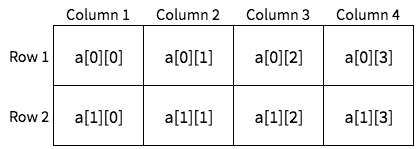
This allows united states of america to talk about 2D arrays in a much easier manner. To use the element at the first row, 3rd cavalcade, you can use a[0][2]; to use the element at the 2nd row, 2nd cavalcade, use a[1][one] and then on.
Initializing, using and looping over second arrays
Apart from using two indexes, using 2D arrays is the same equally using 1D arrays. A bones example of using the arrays is as follows:
int a[ 2 ][ 2 ]; a[ 0 ][ 0 ] = 10 ; a[ 0 ][ 1 ] = a[ 0 ][ 0 ] * x ; // a[0][1] will be set to 100 a[ 1 ][ 0 ] = a[ 0 ][ i ] / 5 ; // a[1][0] volition exist set to twenty a[ 1 ][ one ] = a[ 0 ][ 1 ] + a[ i ][ 0 ]; // a[i][1] volition be set to 120
You can find the total program beneath, or download it hither.
If you know the elements beforehand, yous can also utilise the initializer list syntax that we discussed previously. For example, if yous desire to make the following array:
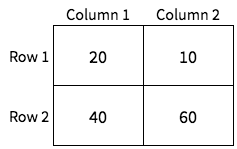 You lot can write it as follows:
int a[ 2 ][ ii ] = { xx , x , xl , 60 };
For easier understanding, yous can besides grouping the elements of the initializer listing by using braces. For instance, to initialize a second array with ii rows and three columns, you can write:
int a[ 2 ][ 3 ] = {{ 10 , twenty , xxx }, { xl , 50 , 60 }};
You can besides loop over, print, or ask for input using scanf() every bit you would with 1D arrays. Here is an example of initializing an array, and then using for loops to print the elements. You can download the lawmaking here.
In the above plan, we have used nested for loops to print the elements of the array. This is because a second array has two indexes, which means that the commencement and 2d index has to be changed individually. Since the printf() call uses a[i][j], and then, the outer loop with variable i changes the offset index, i.e. the row number. The inner loop with variable j changes the column number.
To understand this improve, allow usa footstep through the loops. The outer loop starts with i = 0, and we go to the inner loop. The inner loop starts with j = 0 and ends at j = ii (since j < 3), so we print a[0][0], a[0][1] and a[0][2]. After this, the inner loop value increases to ane, and similarly, we print a[1][0], a[1][1] and a[1][2].
In this fashion, nosotros impress all the elements of the 2nd array.
2nd array program examples in C
In this section, we're going to look at some basic programs involving second arrays in C. Since 2D arrays can be visualized in the class of a tabular array or matrix, all of our examples will revolve effectually the concept of using them for matrix operations.
Reading user-entered numbers into a second array
Before we look at more complex examples, let united states first expect at how to read numbers from the user into an assortment. Here'due south the source code of the program, and yous can download information technology here.
In the program, we brainstorm by initializing an array of ten rows and x columns, along with loop variables besides as variables that store the number of rows and columns requested by the user. Next, we ask the user to enter the number of rows and columns, and then we check if the number of rows and columns volition fit into the 2nd assortment. If it doesn't fit, we print an error and exit the plan.
And so, in the first nested for loop, we ask the user to enter the elements with scanf(). When printing the message "Enter row Ten, column Y", we accept used i + 1 and j + 1 ; this is considering row/column numbers start from ane, but array indexes get-go from 0.
In the 2nd nested for loop, we simply print the elements as we've seen in our previous example.
Finding the transpose of a matrix
When you "transpose" a matrix, you take every element at the ith row and jth column of the matrix, and put it in the jth row and ithursday column. The formula for transpose is equally follows:
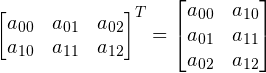
As you can see in this example, the size of a matrix too changes when you "transpose" it. A matrix of size  changes to a matrix of size
  .
.
We can translate the above program into lawmaking quite easily. Suppose, the input array is a and the result assortment is b. Elements in a[i][j] will go into a b[j][i]. Here's the source code for the plan, and you lot tin can download it here:
Only like our previous instance, we declare the arrays are a and b respectively and take 10 rows and 10 columns to hold the input and effect matrix. Side by side, we ask the user to enter the rows and columns. If it exceeds the size of the array, nosotros print an error and leave.
Then, we ask the user to enter the numbers i by one and impress the input matrix. After that, we iterate through the matrix using a nested for loop, and implement the logic where a[i][j] goes to b[j][i].
As we discussed, the matrix size changes when y'all transpose information technology. In all the other loops, we were comparison i < rows and j < cols, but now since the size has changed, we should use i < cols and j < rows. And then, in the last loop, we use this idea and print all the elements of the matrix.
Adding two matrices
In order to add two matrices, both must have the same number of rows and columns. The process of calculation ii matrices involves taking numbers from the same position of the matrix, adding them, and putting the result in the aforementioned position. The formula for matrix addition is equally follows:

So, if we take the two input matrices a and b and the consequence matrix c, then you can use c[i][j] = a[i][j] + b[i][j] in a loop to add the matrices. Hither'south the source lawmaking for the program, and you tin can download information technology here:
In this program, nosotros have two input matrices a and b and one outcome matrix c, and each of them are of 10×10 size. First, we ask the user for the size of the matrices, and if they're bigger than the arrays, we print an error and go out.
Otherwise, nosotros inquire the user to enter the values in the input matrix. So, using a nested for loop, nosotros implement the procedure of matrix addition, c[i][j] = a[i][j] + b[i][j]. Finally, we print all the three matrices.
Multiplying two matrices
Let u.s. presume we take two matrices. One is of size and the other i is  . These matrices tin can exist only multiplied if
  . Later on multiplying, the upshot matrix will have a size of
  .
.
Now, to calculate the result in the ithursday row and jth cavalcade of the result matrix, take all the elements of the ith row of the first matrix, and multiply it with the corresponding value in the jth column. And then, take all these products and make full the sum in the consequence matrix. To see what we mean, permit us take an case of how you can multiply ii 2×2 matrices:

The programme that implements this logic is below. You can download it hither.
In the programme, we first declare 10×ten input and consequence matrices, forth with some loop variables. Merely like our previous programs, we inquire the user for the sizes of the two matrices, and check if they are bigger than the 10×10 size. In add-on, we cheque if the number of columns in the first matrix equals the number of rows in the 2nd matrix. If whatsoever of these conditions fail, nosotros print an fault and exit the program.
Then, nosotros ask the user to enter the numbers for both matrices. Once we've read all the numbers, we calculate the product with a nested loop. The ii outer loops with variables i and j are used to move across the different elements of the result matrix. Initially, we set c[i][j] = 0. Now, we need to pick all the elements from the ith row of the first matrix and jthursday column from the second matrix. So, we use another loop with the variable k that helps us with this and multiplies and adds all the elements.
Finally, nosotros brandish the input and result matrices.
Multidimensional arrays in C
In the previous sections, we accept seen 1D and 2D arrays. Whatever array with more than one dimension is a multidimensional assortment, and the concept tin exist extended to any number of dimensions, with the basics staying the same.
For case, a 3 dimensional (3D) array is a combination of multiple 2nd arrays, and you can initialize a three dimensional array by using something like:
int a[ 3 ][ 2 ][ ii ];
This statement creates a 3D array which is a combination of iii 2×two 2D arrays. Equally with all arrays in C, memory resource allotment is face-to-face and all the elements is initialized to null. You can think of this array every bit follows:
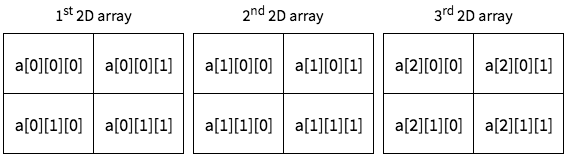
To utilise any chemical element of the array, you need to use three indexes. For case, writing a[0][1][one] will access the first second array's 2d row and 2nd column.
You can also use initializer lists with 3D arrays. Here is an instance:
int a[ 3 ][ 2 ][ 2 ] = { { { 10 , xx }, { 30 , 40 }, }, { { 1 , 2 }, { iv , 5 } }, { { 3 , 5 }, { 7 , 11 } } };
In the to a higher place case, the commencement second array'southward first row is initialized to x, xx, and the 2nd row is initialized to 30, forty. Similarly, the 2nd 2D array's first row is initialized with one, ii; the 2nd row is initialized to 4, five, and so on.
To iterate over a 3D assortment, y'all need to nest three for loops. The outer loop to change the outermost index. The loop inside it changes the centre alphabetize, and the innermost loop changes the concluding index. To see what we mean, have a look at the example below which initializes the array and prints all its elements. You can download it here.
Similarly, for a 4 dimensional array, y'all demand to nest iv for loops, and admission it with iv indexes, similar a[0][one][4][2].
Strings in C: Arrays of Characters
In C, strings are only an array of characters followed by the "nix terminating character". The zilch terminating character is a character with the integer value zero, and it is used to represent the end of a string.
Permit us see how y'all can define a string. If you want to create a string with the content "world", you lot can use the "initializer string" syntax. It looks like this:
char s[] = " world " ;
The array s is six characters in length, because, apart from the characters "w", "o", "r", "50", "d", there is also a zippo terminating character in the array.
You can besides employ the "initializer listing" syntax to declare strings. However, in this instance, the C compiler won't put in the zero terminating character for you, so you have to manually put it in. In C, '\0' is used to represent this character, so you would have to use:
char string[] = { ' w ' , ' o ' , ' r ' , ' l ' , ' d ' , ' \0 ' };
With the initializer list/string syntax, you can too set the array size manually if you wish to, but this isn't necessary:
char string[ 6 ] = { ' w ' , ' o ' , ' r ' , ' l ' , ' d ' , ' \0 ' }; char string[ 6 ] = " world " ; // aforementioned as to a higher place
Even so, at that place is one special case. If you lot write something like this:
char string[ 5 ] = " globe " ;
The C compiler will declare an array of five characters. Withal, since in that location is no space to fit the null terminating character, it will not add together it to the string. However, for this case, you can't put a size less than v, and C compilers will throw an error.
char string[ 4 ] = " world " ; // wrong!
C provides multiple cord manipulation functions in the header file string.h. However, this is outside the scope of arrays, so we will not discuss it here.

hartsocktrainsomill1963.blogspot.com
Source: https://www.booleanworld.com/arrays-in-c/
0 Response to "How to Read Array Into Array C++"
Post a Comment