Hwhat Is the Role of Art in Anciet Islam
Introduction to Islamic Art
One expanse where the genius of the Muslim civilisation has been recognised worldwide is that of art. The artists of the Islamic world adapted their inventiveness to evoke their inner beliefs in a series of abstract forms, producing some amazing works of fine art. Rejecting the delineation of living forms, these artists progressively established a new way substantially deviating from the Roman and Byzantine art of their time. In the mind of these artists, works of art are very much connected to ways of transmitting the bulletin of Islam rather than the material grade used in other cultures. This article briefly examines the meaning and character of fine art in Islamic civilization and explores its chief decorative forms-floral, geometrical, and calligraphic. Finally, it looks at the influence of the art developed in the world of Islam on the art of other cultures, peculiarly that of Europe.
Rabah Saoud*
Table of contents
1. Introduction
2. Comparison with Byzantine Art
three. Sources of the Islamic Art
iv. The Nature and Form in Islamic Art
5. Vegetal and Floral fine art
half-dozen. Geometrical Art
vii. Calligraphy
viii. Influence of Islamic Art in the West
ix. Conclusion
10. References
***
Note of the editor
This article was kickoff published in July 2004. It is edited hither in HTML, with revision. © FSTC 2004-2010.
***
ane. Introduction
The fine art of Islam has attracted the attention of a number of Western scholars [1] who gained good reputations considering of their contributions to the written report and publicising of the field. Despite this positive aspect, their work contained an element of prejudice equally they repeatedly practical their Western norms and criteria to their evaluation of the art produced in Islamic history. In their views, far from contributing to the arts of its social club, Islam has restricted, diminished and undervalued artistic inventiveness. Islam is seen every bit obstructive and limiting to creative talent and its art is often judged by its incapacity to produce figures and natural and dramatic scenes. Such arguments illustrate a serious misperception of Islam and its attitude to fine art. The view that Islam promotes harsh and simple living and rejects composure and condolement is an accusation ofttimes made by orientalist academics. This false claim is rejected by both the Qur'an and the example of Prophet Muhammad. The Qur'an, for example, permits comfortable living if it does non lead the believer astray:
"Say, who is there to forbid the dazzler which God has brought forth for his servants, and the skillful things from among the ways of sustenance" (Qur'an 7:32).
This message is emphasised over again in some other verse:
"O you who believe! Practise not deprive yourselves of the skilful things of life which Allah has permitted y'all, simply do not transgress, for Allah does not dearest those who transgress." (Qur'an five:87).
The authentic saying of Prophet Muhammad which was narrated by Al-Boukhari:
"Allah is cute and loves dazzler."
This is perhaps the clearest translation of the position of Islam towards fine art. Beauty, in Islam, is a quality of the divine. The great scholar Al-Ghazali (1058-1128) considered it to be based on two main criteria involving the prefect proportion and the luminosity, encompassing both outer and inner parts of things, animals and humans.
The other determinant factor influencing Western scholars' views on Islamic art is connected to the Greek-influenced approach which considers the prototype of man as the source of artistic creativity. Thus, portraits and sculptures of man were seen as the highest work of fine art. According to this view, man is nature's almost magnificent and nearly beautiful beast and should exist both the beginning and destination of homo artistic try. Successful works of fine art are those which explore the inner depth and external physical advent of the human body. Perhaps the highest position given to man, in this art, is when divine beings are represented in his form, or when he is represented every bit beingness created in the image of the Deity. Islamic art, however, has a radically different outlook. Here, man is seen every bit an instrument of divinity created by a supremely powerful Being, Allah.
2. Comparing with Byzantine Art
Byzantine fine art was fundamentally based on the incorporation of Christian themes into Greek humanism and naturalism. Together, these concepts symbolised and reflected divinity. Man and nature were seen equally the prototype of the divine. This new figurative art was non seeking the aesthetic per se, as in the Greek tradition, just striving to translate concepts in Christian belief such every bit salvation and sacrifice.
Every bit they do with many fields, Western scholars frequently relate Islamic art to Greek and Byzantine origins, challenge that the artists of the Muslim world only imitated or borrowed from these 2 cultures their art and reproduced it in a Muslim "wearing apparel" of Arabesque and calligraphy. Byzantine inspiration started in the early stages of the Muslim Caliphate when the Umayyad Caliphs Abd-al-Malik [2] and Al-Walid I [3] sent for Byzantine artists to decorate the Dome of the Rock (691-92) and the Bully Umayyad Mosque of Damascus (705-714). Byzantine influence is seen in the iconographic themes in the Dome of the Stone, every bit reflected in the mosaics of crowns and jewels of that mosque, which Grabar (1973) believed were emulating Byzantine symbols of power. These decorations were symbols of holiness, power and sovereignty in Byzantine art. Pursuing this theme, he says:
"In other words, the ornament of the Dome of the Rock witnesses a conscious use by the decorators of this Islamic sanctuary of representations of symbols belonging to the subdued orto the stillactive enemies of Islam" (Grabar 1973, p. 48).
Withal, Grabar afterward admits that the Arabs, both before and later Islam, used to offer their precious holding, including crowns, to the Kaabah and hang them there [4].
In relation to vegetal representations, in Grabar'south view, once again the artists of Islam seem to borrow from Byzantine depictions of sky as if they lacked whatever knowledge or literary description of it. He claims that Byzantine art was so consummate and superior that the Muslims had to emulate it. Faced with the question of why the Muslims did non adopt figurative art, Grabar argued that they had to give it upwardly due to the superiority of the Byzantine art which they could non compete with. He says that:
"the Umayyads could inappreciably in i generation acquire the sophisticated practice of imagery which characterised Byzantium. Faced with this dilemma, the Muslims tried both alternatives, but shortly discarded imagery, and, every bit nosotros have seen adopted the techniques of Byzantium without its formulas".
Grabar clearly disregarded the opposition of Islam to imagery, which is exemplified in a number of the Prophet Muhammad sayings (encounter beneath).
Von Grunedaum (1955) provided a more comprehensive view arguing that the lack of imagery was due to the position of man in the Islamic religion. An important attribute of Muslim theology was the prominence of the attributes separating God, the Creator, and man, his favourite creature. Man is guided by and subject area to his fate and therefore cannot reach the position of God, which other religions say he can attain. The fundamental principles of art in Islamic culture are the declared truths that there is "no god but God" and "nothing is like unto Him"; His realm is neither infinite nor fourth dimension and He is known past ninety nine attributes, including the Offset and the Concluding, and the Seen and the Unseen, and the All-Knowing:
Allah! At that place is no god but He, the Living, the Self-subsisting' Eternal. No sleep can seize Him nor sleep. His are all things in the heavens and on earth. Who is there that tin intercede in His presence except as He permits? He knows what (appears to His creatures) before or later on or behind them. Nor shall they compass aught of His knowledge except every bit He volition. His Throne doth extend over the heavens and the earth, and He feels no fatigue in guarding and preserving them for He is the Nearly Loftier, the Supreme (in celebrity) (Qur'an2:255).
This is perhaps the main partition in the philosophy and approach towards fine art between the Muslims and non-Muslims. With this approach, Islamic art did non need whatsoever figurative representation of these concepts. How tin can he depict God if he believes that He is the Unseen and nothing is like unto Him? Whatever artistic expression of these, either in natural or human being forms, would undermine the meanings and the essence of the Muslim faith. Consequently, artists engaged in expressing this truth in a sophisticated system of geometric, vegetal and calligraphic patterns (Al-Faruqi, 1973). Islam was the only religion that did not need figurative art and imagery to establish its concepts (Von Grunedaum, 1955).
iii. Sources of Islamic Art
Like other aspects of Islamic culture, Islamic art was a result of the accumulated cognition of local environments [5] and societies, incorporating Arabic, Persian, Mesopotamian and African traditions, in addition to Byzantine inspirations. Islam congenital on this knowledge and developed its ain unique manner, inspired by 3 master elements.
The Qur'an is seen as the first work of art in Islam and its chef-d'oeuvre (Al-Faruqi, 1973). The independence of some verses and the interrelation of others class boggling meanings every bit each poesy takes the reader into a unique divine feel feeling its joy and happiness, terror and fearfulness, elation and acrimony, and then on. The constant repetition of these experiences in the verses of the Qur'an "winds upwards consciousness and generates in it a momentum which launches it on a continuation or repetition and infinitum" (Al-Faruqi 1973, p.95). The final outcome of this experience makes the reader feel the presence of God as described in the verse:
"when the verses of the Beneficent are recited unto them, they autumn down prostrate in adoration and tears" (Qur'an 19:58).
Every bit a result, artists drew lessons and methods from their experience of the Qur'an, developing a new approach to art characterised by the independence and interdependence of its formative elements. The accent was on the presence and attributes of the divine Creator rather than on His creatures, including man. Islam sees all men equal regardless of colour or form (perfect or imperfect). The only distinction between them is made on the ground of their piety. Consequently, Islam sees the white-skinned and off-white-haired ideal of man promoted past Western fine art every bit racial and misleading.
The second element comes from the Qur'anic verses which criticises poets as:
"As for the poets, the erring follow them. Have you not seen how they wander distracted in every valley? And how they say what they do not? (Qur'an 26:224-26).
This formula regulates the arroyo of artists, writers and professionals. Islam merely approves work from
"those who believe, do skilful work, and engage much in the remembrance of Allah" (Qur'an 26:227).
With this background, the artist's piece of work was guided by this benchmark and was always connected to the remembrance of God whether it was in ceramics, textile, leather or iron piece of work or wall ornamentation. The ways this remembrance was expressed was, of class, many. Artists worked with many different materials, from ceramic to atomic number 26, and their artistic fashion took many forms, such as Arabesque designs, geometrical patterns and calligraphy.
The third decisive gene dictating the nature of fine art in Islamic culture is the religious rule that discourages the depiction of human or animal forms [six]. The presence of this rule is due to a concern that people would go dorsum to the worship of idols and figures, a exercise that is strongly condemned by Islam. In the early days of Islam, sculpture and imagery were seen every bit reminders of the despised idolatrous past. Today, the majority of Muslims still respect this rule and their attitude extends to dislike the excessive "body worship" practised in the West. The latter can be seen in the revival of Islamic dress among educated Muslim women and in their avoidance of the excessive use of make-upwardly.
Furthermore, Islam is free from metaphysical arguments such equally those relating to the trinity, the true nature of Christ, the Holy Spirit and saints hierarchy, equally constitute in Christianity. Consequently, at that place was no need in the mosque for apses, transepts, crypts every bit well as images and sculptures of saints, angels and martyrs that played a prominent part in didactic art in Christian churches. Nevertheless, there were some instances where homo and beast forms were used in Islamic fine art, but these were mainly found in secular private buildings of some princes and wealthy patrons. Discoveries made in the Qasre Amra palace, built past the Umayyad Caliph Al-Walid I (705-715) in the Jordanian desert, revealed large illustrations of hunting scenes, gymnastic exercises, and symbolic figures. The virtually important of these were illustrations depicting the principal enemies of Islam, Kaisar (the Byzantine Emperor), Roderick (the Visigoth King of Spain), and Khosrow (the Emperor of Persia). There was also an analogy of the Negus, the Abyssinian king, who gave the Muslims refuge when they were being prosecuted in Mecca in the early days of Islam [seven] (Creswell 1958, p.92).
In relation to the depiction of animal forms, many examples were discovered. Lions and eagles, for instance, were found in illustrations of hunting scenes, and carved in sculptures and heraldic emblems. These emblems were transmitted by the Crusaders to Europe where they were widely copied.
4. The Nature and Grade in Islamic Art
Islamic art differs from that of other cultures in its form and the materials it uses as well as in its subject and significant. Philipps (1915), for example, idea that Eastern fine art, in full general, is mainly concerned with colour, unlike that of western art, which is more than interested in class. He described Eastern fine art as feminine, emotional, and a thing of colour, in contrast to Western fine art which he saw every bit masculine, intellectual, and based on plastic forms which disregarded colour. Of form this reflected Philipps' cultural and artistic bias. Art in Islam never lacked intellectualism even in its simplest forms.
The invitation to observe and larn is constitute in both revealed and hidden messages in all its forms. Bourgoin (1879), on the other paw, compared the fine art forms of Greek, Japanese and Islamic cultures and classified them into three categories involving animal, vegetal, and mineral respectively. In his view, Greek art emphasised proportion and plastic forms, and the characteristics of human being and animal bodies. Japanese fine art, on the other hand, developed vegetal attributes relating to the principle of growth and the beauty of leaves and branches. However, Islamic art is characterised by an illustration betwixt geometrical blueprint and crystal forms of certain minerals. The main divergence between it and the art of other cultures is that it concentrates on pure abstract forms every bit opposed to the representation of natural objects. These forms take diverse shapes and patterns. Prisse (1878) classified them into 3 types, floral, geometrical and calligraphic. Another classification was suggested past Bourgoin (1873) involving ornamental stalactites, geometrical arabesque, and other forms. For our decorative involvement, we concentrate on the three forms suggested by Prisse, which announced, either alone or together, in most media, such as ceramics, pottery, stucco or textile.
 |
| Effigy 1: Detail of a floral decoration in the Dome of the Stone Mosque. |
5. Vegetal and Floral fine art
Although, Muslim art was not, of course, developed independently of influences from nature and the environment, their representation was abstruse rather than realistic, equally in Western art. This is seen conspicuously in vegetal forms where plant branches, leaves, and flowers were woven and interlaced into and oftentimes not distinguished, from the geometrical lines around them as seen in the arabesque. The use of vegetal forms in Islamic art is also conditioned to some extent by the Islamic prohibition of the imitation of living creatures. Nevertheless, this interdiction naturally decreases with the descent from human to animal to vegetable forms. Art critics describe the floral depictions and ornaments of the artists of Islam equally conventional; defective the effects of growth and the cosmos of life (Dobree 1920). In their opinion, the reason behind the absence of growth was due to the natural environment of the Muslim countries, where the feel of spring, the season of constitute growth is fleeting. Even so, the religious prohibition mentioned above was backside the absenteeism of lifelike cosmos in much of the Islamic floral fine art.
 |
| Figure 2: Illustration of a tree in a mural decoration in the Umayyad Mosque in Damascus. |
In the Dome of the Stone and the Umayyad Mosque of Damascus, which comprise the earliest examples of Islamic vegetal art, we observe more realistic depictions of plants and trees, but these examples, equally noted before, are regarded as Byzantine work for the Umayyad patrons. In contrast, the vegetal ornament in Samarra Mosque (Iraq) shows how artists, in dissimilarity, deliberately reproduced the vine leaves and branches in an abstract form. However, by the 13th century a more realistic approach gradually gained ground in Muslim Persia and Turkey, influenced by the Chinese and the Mongols (Al-Ulfi, 1969, p.114).
The Muslims used foliage with not bad delicacy especially around the arches and windows. The stucco borders used in the mausoleum of the Ayyubid Sultan Qalawun, built in Cairo (Egypt) in 1284/85, consisted of buds and leaves arranged in a continuous roll blueprint. The mausoleum also independent examples of other floral illustrations set in rectangular and circular panels, a characteristic which became particularly pop in the 15th century (Poole, 1886). The employ of this type of art extended to many ornamental objects, such equally pottery, and wood and leather carving equally well every bit coloured tiles.
6. Geometrical Art
The 2nd element of Islamic fine art involves geometrical patterns. The artists used and developed geometrical art for two principal reasons. The showtime reason is that it provided an alternative to the prohibited depiction of living creatures. Abstract geometrical forms were particularly favoured in mosques considering they encourage spiritual contemplation, in contrast to portrayals of living creatures, which divert attention to the desires of creatures rather than the volition of God. Thus geometry became fundamental to the fine art of the Muslim Globe, allowing artists to gratuitous their imagination and creativity. A new form of art, based wholly on mathematical shapes and forms, such as circles, squares and triangles, emerged.
The second reason for the evolution of geometrical art was the sophistication and popularity of the science of geometry in the Muslim world. The recently discovered Topkapi Scrolls [8], dating from the fifteenth century, illustrate the systematic use of geometry by Muslim artists and architects (see Gülru, 1995). They also bear witness that early on Muslim craftsmen developed theoretical rules for the use of aesthetic geometry, denying the claims of some Orientalists that Islamic geometrical fine art was developed by accident (due east.1000. H. Saladin 1899).
This geometrical art is very much continued to the famous concept of the arabesque, which is defined as "ornamental work used for flat surfaces consisting of interlacing geometrical patterns of polygons, circles, and interlocked lines and curves" (Chambers Scientific discipline and Applied science Lexicon 1991).
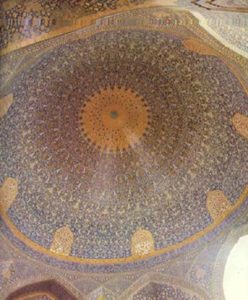 |
| Effigy 3: Floral Arabesque covering the interior of the dome of Masjid-i Shah Mosque, Isfahan (16111616). |
The arabesque blueprint is composed of many units joined and interlaced together, flowing from each other in all directions. Each unit, although it is independent and consummate and can stand alone, forms part of the whole design; a note in the general rhythm of the design (Al-Faruqi 1973). The well-nigh common use of arabesque is decorative, consisting mainly of a ii dimensional blueprint, covering surfaces such as ceilings, walls, carpets, furniture, and textiles. From his written report of 200 examples, Bourgoin (1879) ended that this manner of fine art required a considerable knowledge of applied geometry, which its practitioners must have had. In his view, the arabesque blueprint is congenital up on a system of joint and orbiculation and is ultimately capable of beingness reduced to 1 of 9 elementary polygonal elements. The pattern may be built upward of rectilinear lines, curvilinear lines, or both combined together, producing a cusped or foliated event. It is reported that Leonardo da Vinci establish Arabesque fascinating and used to spend considerable time working out complicated patterns (Briggs, 1924, p.178).
Arabesque can also be floral, using a stalk, foliage, or flower (tawriq) as its artistic medium, or a combination of both floral and geometric patterns. The expression embodied in its interlacing blueprint, cohesive move, gravity, mass, and volume signifies infinity and produces a contemplative feeling in the spectator leading him slowly into the depth of the Divine presence (Al-Alfi 1969). Dobree (1920) explained the bear on of Arabesque art equally follows:
"Arabesque strives, non to concentrate the attending upon whatsoever definite object, to liven and quicken the beholden faculties, but to lengthened them. It is centrifugal, and leads to a kind of abstraction, a kind of cocky-hypnotism even, so that the devotee kneeling towards Makkah tin can bemuse himself in the maze of regular patterning that face up shim, and free his mind from all connection with bodily and earthly things" (quoted in Briggs1924, p.175).
It is clearly axiomatic that much of the credit for the development and the popularity of geometrical art goes to the artists of the Islamic world, although its origins are still debated. Claims take been made that primitive geometrical ornament was used in Aboriginal Arab republic of egypt as well as in Mesopotamia, Persia, Syrian arab republic, and Republic of india. The star pattern, for example, was widely used past the Copts of Egypt (Gayet, 1893), but the artists of the earth of Islam were its all time masters.
 |
| Figure four: Kufic Lettering (from Al-Jiburi, 1974). |
7. Calligraphy
The third decorative form of art developed in Islamic culture was calligraphy, which consists of the utilise of artistic lettering, sometimes combined with geometrical and natural forms. As in other forms of Islamic art, Western scholars attempted to chronicle calligraphy to the lettering art of other cultures. The decorative apply of letters in both People's republic of china and Japan seem to be an expanse of interest to them. Theories claiming that the development of Islamic calligraphy was influenced by the Chinese, dubiously based on the pottery plant in sometime Cairo (Al-Fustat), seem to be absurd (Christie, 1922). The lack of any substantiated proof is articulate evidence as are the wide differences between the two languages in the way and the direction they are written. The suggestion of whatever link betwixt Islamic calligraphy and aboriginal is besides inconceivable. It is truthful that the ancient Egyptians widely used hieroglyphics on wall paintings, but these had no decorative purpose (Briggs 1924, p.179).
 |
| Figure v: Kufic calligraphy combined with floral and geometrical decoration with intersecting horseshoe arches. Plate on Cordoba Mosque façade. |
The evolution of calligraphy equally a decorative art was due to a number of factors. The starting time of these is the importance which Muslims attach to their Holy Volume, the Qur'an, which promises divine blessings to those who read and write it down. The pen, a symbol of knowledge, is given a special significance by the verse:
"Read! Your Lord is the Most Bounteous, Who has taught the use of the pen, taught man what he did not know" (Qur'an 96:3-v).
This indicates that the aim of Islamic calligraphy was not merely to provide ornamentation but also to worship and remember Allah. The Qur'anic verses mostly used are those which are said in the act of worship [ix], or incorporate supplications, or depict some of the characters of Allah, or his Prophet Muhammad. Calligraphy is as well used on dedication stones to record the foundation of some key Islamic buildings. In this case, a man is referred to every bit the founder, often a Caliph or an Emir, but he was consciously described every bit poor to Godor Slave of God, a reminder of his position before Allah.
The second factor behind the advent of Arabic calligraphy is attached to the importance of the Arabic language in Islam. The apply of Arabic is compulsory in prayers and it is the language of the Qur'an and the language of Paradise (see Rice, 1979). Furthermore, the Arabs have ever attached a considerable importance to writing, emanating from their appreciation of literature and poetry. It is reported that the Prophet Muhammad said:
"Seek squeamish writing for it is one of the keys of subsistence" and the fourth Caliph, Ali commented on calligraphy every bit:
"The beautiful writing strengthens the clarity of righteousness"
(both quotes from Al-Jaburi 1974).
In addition, the mystic ability attributed to some words, names and sentences as protections confronting evil also contributed to the development of calligraphy and its popularisation.
Arabic calligraphy was by and large written in two scripts [ten]. The first is the Kufic script, whose name is derived from the city of Kufa, where it was invented by scribes engaged in the transcription of the Qur'an who gear up up a famous school of writing [eleven]. The letters of this script have a rectangular form, which made them well suited to architectural utilise.
 |
| Effigy half dozen: Transcript of Naskhi calligraphy past Mahmud Yazre. |
The other script of Standard arabic calligraphy is known equally Naskhi. This style of Standard arabic writing is older than Kufic, yet it resembles the characters used by modern Arabic writing and printing. It is characterised by a circular and cursive shape to its letters. The Naskhi calligraphy became more pop than Kufic and was substantially developed past the Ottomans (Al-Jaburi 1974).
8. Influence of Islamic Art in the West
In general, the diffusion of the Islamic art motifs to Europe and the rest of the globe occurred in three different means. The first of these was directly faux through the reproduction of the same theme in the same type of medium. For example, an artistic theme (or themes) in an Islamic ceramic could have been reproduced in a European ceramic. There are a multitude of examples of this kind of imitation. Perhaps the most widely acknowledged ones are the many instances of copying of Kufic inscriptions in Medieval and Renaissance European art. According to Christie (1922), Kufic inscriptions in the Ibn Tulun Mosque, built in Cairo in 879, were reproduced in Gothic fine art showtime in France, and so in the rest of Europe. Lethaby (1904) also attributed to the carved pattern of wooden doors in a chapel of the Cathedral of Le Puy (France), and of another door in the church of la Vaute Chillac nearby, which were fabricated past the Primary carver "Gan Fredus". This connection is attributed to the special relationship Amalfi had with Fatimid Cairo at that time. Amalfitan traders visiting Cairo were believed to be responsible for the transmission of these motifs to Europe.
 |
| Effigy 7: Tiles in the Alhambra Palace showing geometrical Decorations and Naskhi Calligraphy, Granada, Kingdom of spain. |
Male (1928) establish traces of Islamic influence in many religious buildings of Southern France, in the region known as the Midi. The list of Islamic motifs, which he collated from these buildings, included horseshoe and multifoil arches and polychromy. Male believed they were copied from Andalusia. Islamic influences were likewise traced in Westminster Abbey in London, in bands of ornaments in the retable as well as in the earlier stained drinking glass windows (Lethaby 1904). This was not all. Motifs such as the eight pointed star, the stalactite, the Ottoman bloom (tulip and carnation) and Alhambra geometrical and colour schemes are merely a few items that class an essential part of most European works of art (come across Fikri 1934) [12]. In addition, it is widely held that Gothic geometrical medallions such as polyfoil, quatrefoil or the foliated foursquare were besides of Islamic origin (Marcais, 1945).
The second way Islamic art motifs were transferred to Europe was through the transposition of source or media. In this case, an Islamic theme in a particular medium was reproduced in a European piece of work of fine art in a different type of medium. For case, a theme in an Islamic ceramic work could accept been reproduced in European furniture, textile, sculpture and and then on. Examples of this type of transfer are in one case over again very all-encompassing, and nosotros cannot cover them all here. The example of arabesque must suffice. According to Ward (1967), the fertilisation of European ornamental art during the Renaissance (16th century) was at the easily of arabesque. Arabesque and other Islamic geometrical patterns invaded European salons, living rooms, and public reception halls.
 |
| Figure eight: View of Al-Azhar mosque courtyard in Cairo. |
The third way of transfer is the nearly difficult to explain. Here, the motif was not copied or reproduced but gradually inspired the development of a particular style or mode of art. At that place is increasing evidence that Islamic art, and the arabesque in particular, was the inspiration for both the European Rococo and Baroque styles which were popular in Europe between the xvith and eighteenth centuries (Jairazbhoy, 1965). The Rococo manner consisted of light curvilinear ornamentation composed of abstract sinuosities such as scrolls, interlacing lines and arabesque designs. It was developed in France in the 18th century, and afterwards spread to Federal republic of germany and Austria. The germ of this fashion is found in the Islamic Aljaferia Palace (also known as Hudid Palace), built in northern Kingdom of spain in the xith century, where a number of blind arches and squinches in a style very similar to Rococo decorate its small mosque (Jairazbhoy, 1973). Other examples of this early "Islamic Rococo" are found in the Great Mosque of Tlemcen, Algeria, which was built in 1136.
Bizarre architecture has also been traced dorsum to an Islamic origin. According to some sources (for case Jairazbhoy 1965), the word "baroque" is ultimately derived from the Arabic word of burga, significant "uneven surface", which was the source of the discussion barrocco in Portuguese, which meant "irregularly shaped pearl".
 |
| Figure 9: Decorative arcade in Aljaferia showing elements that afterwards inspired the Baroque way. |
Muslims used motifs such as curviangular arches and squinches, which characterise the Baroque style, in their decorative art equally early on as the 12th century. They became especially popular under the Almoravid rulers (al-Murabitunin Arabic) who ruled Northward Africa and Andalusia between 1062 and 1150.
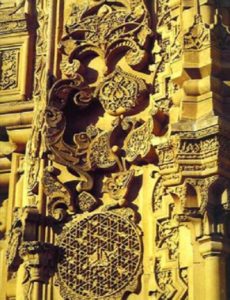 |
| Effigy ten: Northern entrance of the Ulu Cami Infirmary (13th century) showing a close upwardly view of "Baroque" features. |
In addition to the in a higher place, a more complicated decorative style, consisting of a combination of multifoil arches intersecting with one another similar a screen mesh, is constitute in the Aljaferia Palace as well every bit in mosques of Tlemcen (1136) and Qarawiyyin, built in Kingdom of morocco between 1135 and 1143. Another instance is the Ulu Cami Hospital in Divrighi, Turkey, completed in 1229, which shows a remarkable resemblance to Baroque in its ornament and décor, fifty-fifty though information technology predates it past four hundred years.
9. Conclusion
The main objective of this paper has been to emphasise the uniqueness of Islamic fine art, which was defined by religious behavior and cultural values prohibiting the depiction of living creatures including humans. The other most important feature is the absence of religious representation. In Islam, worship is due but to God, a feature mutual to many cultures, although they arroyo it in different manners. Art critics propound the neutrality of Islamic art, which made it easily adjustable to these cultures. Due peradventure due to its geographic proximity and religious "common ground", no other civilization was more than exposed to the themes and motifs of Islamic art than the European. Despite their differences, Islam and Christianity share virtually of their fundamental beliefs which are continued to the same God, the same origin (of the bulletin), and sometimes the same moral message. It is non surprising that vestiges of Islamic art were repeatedly traced in major European artworks, a fact which denotes its significance in the historical evolution of European art.
10. References
- Al-Alfi Abu Saleh (1969). The Muslim Fine art, its origins, philosophy and schools (in Arabic). Dar Al-ma'arif, Cairo.
- Al-Faruqi, R. (1973). "Islam and Art", Studia Islamica, vol. 3 vii, Larose, Paris, pp. 81-110.
- Al-Jaburi, Mahmud Shukri (1974). The Birth of Arabic Calligraphy and its development (in Standard arabic). Library Al-shark al-Jadid, Baghdad.
- Bourgoin, J. (1873), "Les Arts Arabes", Paris. (Cited by Briggs 1924).
- Bourgoin, J. (1879). Les Eléments de I'Art Arabe, Paris. (Cited by Briggs 1924).
- Briggs, Thousand.S. (1924). Muhammadan Architecture in Egypt and Palestine. Clarendon Printing, Oxford.
- Christie, A. H. (1922). "Development of ornamentation from Arabic manuscripts", Burlington Magazine, vo. 41, pp.286-288.
- Creswell One thousand.A.C. (1958). A Short Account of Early Muslim Compages. Penguin Books, London.
- Dieulafoy, Grand. (1903). Fine art in Spain and Portugal. Heinemann, London.
- Dobree, B. (1920). "Arabic Art in Arab republic of egypt", The Burlington Magazine, vol.36, pp.31-35.
- Fikri, A. (1934). Fifty'Art de Roman du Puy et les influences islamiques, Librairie Ernest Leroux, Paris.
- Gayet, A. (1893). 50'Art Arabe', Paris.
- Grabar, 0. (1976). "The Umayyad Dome of the Rock in Jerusalem", in Grabar, 0. (1976), Studies in Medieval Islamic Art, Variorum Reprints, London, pp. 33-62.
- Grabar, 0. (1976). "Islamic Fine art and Byzantium", in Grabar, 0. (I 976), Studies in Medieval Islamic Art, Variorum Reprints, London, pp. 69-83.
- Jairazbhoy, R. A. (1965). Oriental Influences on Western Fine art. Asia Publishing House, London.
- Lethaby, W.R. (1904). Medieval and Co. London, Charles Scribner's Sons, New York, vol.4.
- Male, E (1928). Art et Artistes du Moyen Age. Libraxie Armand Colin, Paris.
- Marcais, G. (1945). "Le care quadrilobe: histoire d'une forme décorative de l'art gothiqueé, Etudes d'art du Musée d'Alger, vol. 1, pp. 67-78.
- Gulru, Necipoglu, et.al. (1995). The Topkapi Scroll: Geometry and Ornament in Islamic Architecture. Geny Research Constitute.
- Poole, L. (1886). Saracenic Fine art. London.
- Prisse d'Avennes (1878). Fifty'Fine art Arabe d'après les monuments du Caire. Morel, Paris.
- Read, R. (1937). Fine art and Order. Heinemann, London.
- Read, H. (I 949). The Meaning of Art. Penguin Books, London.
- Saladin, H. (1899). La Grande Mosquée de Kairawan. Paris.
- Rice, D.T. (1979). Islamic Art. Tharnes & Hudson, Norwich.
- Von Grünebaum, Chiliad. E. (1955). "Idéologie musulmane et esthétique arabe", Studia Islamica, vol. iii, Larose, Paris, pp. 5-23.
- Walker, P. K. B. (editor), (1990), Chambers Science and Technology Dictionary. Chambers Harrap Publishers, Hardcover.
Footnotes
[i] Notably R. Ettinghaussen, E. Herzfeld, Chiliad. A. C. Creswell, and A. Grabar.
[two] Reigned between (685-705).
[3] Reigned betwixt (705-715).
[4] Until the fourth dimension of Ibn Zubayr, who ruled Makkah between 678-693, The Kaabah was adorned with the horns of the ram sacrificed by the Prophet Ibrahim, in place of his son Ismail. The Caliph Umar Ibn Al-Kahttab too hung there two crescent shaped ornaments from the Persian Capital letter, Al-Madain. Almost of the successive Umayyad and Abbasid Caliphs also sent precious items to the Kaabah every bit gifts, to decorate the House of Allah.
[5] Read (1937), for example, talked about ecology determinism in art. He argued that there are ii principal approaches to artistic expression: organic and geometric. The former appears mainly in areas of natural dazzler and favourable environs. In this case, the artist is more attracted to depicting cute landscapes, seashores, plants, animals and humans. Geometric art, on the other hand, appears in societies of harsh natural and environmental weather such as deserts or tundra.
[6] Although no reference to their prohibition is establish in the Qur'an, a number of authentic sayings of the Prophet Muhammad did forbid them. An case of this is the Hadith reported by Muslim who narrated that Ibn Abbas: "I heard the Messenger of Allah maxim: 'All those who paint pictures will be in the Burn down of Hell. The soul will be breathed in every film prepared by the man and it punishes them in Hell" (Narrated by Muslim, 3945). Muslim scholars accept different views on this matter. Some of them, specially those from the Shia schoolhouse of idea permit the imaging of living beings. Others, such as Mohammed Abdu, allow imagery and photography as long they do non conflict with 1's beliefs or worship. Al-Ulfi (1969) reported that he said of photography: "In general I am inclined to think that Islamic police (Shariah) does not forbid one of the best means of learning, especially if it does not conflict with the Islamic behavior and worship" (see Al-Ulfi, 1969, p.84).
[7] It is believed that he converted to Islam. It was reported that on hearing well-nigh his death, the Prophet Muhammad performed prayers for his soul.
[8] The scrolls, thought to be a Timurid manuscript, incorporate 114 private geometric patterns for wall surfaces and vaulting.
[9] Surah Al-Fatiha, for instance, is particularly favoured since it is the opening of the Qur'an and is said in all prayers.
[ten] From these two main styles, a number of other sub-styles emerged every bit calligraphers introduced new modifications to the original way. The nearly familiar ones are Thuluth, Al-Rakaa, Al-Diwany, Jali Diwany, and Persain.
[xi] Co-ordinate to Al-Jaburi (1974), after the establishment of Kufa, some Yemeni tribes who knew an early on course of this lettering style settled there. This manner attained its complete shape under the reign of the fourth Caliph (Ali), between 657 and 661, who was a calligrapher himself.
[12] This splendid PhD thesis published by A.Fikri was devoted to the influence of Islamic art and architecture on southern France, specially in the Auvergne region.
*Dr Rabah Saud wrote this article for www.MuslimHeritage.com when he was a researcher at FSTC in Manchester. He is now Assistant Professor at the University of Ajman, Ajman, UAE.
hartsocktrainsomill1963.blogspot.com
Source: https://muslimheritage.com/introduction-to-islamic-art/
0 Response to "Hwhat Is the Role of Art in Anciet Islam"
Post a Comment